Forearm Stand Yoga: Focus, Strength and Confidence
Explore how forearm stand yoga develops balance, body awareness, focus, and confidence. Learn about preparation, technique, and mindful practice.
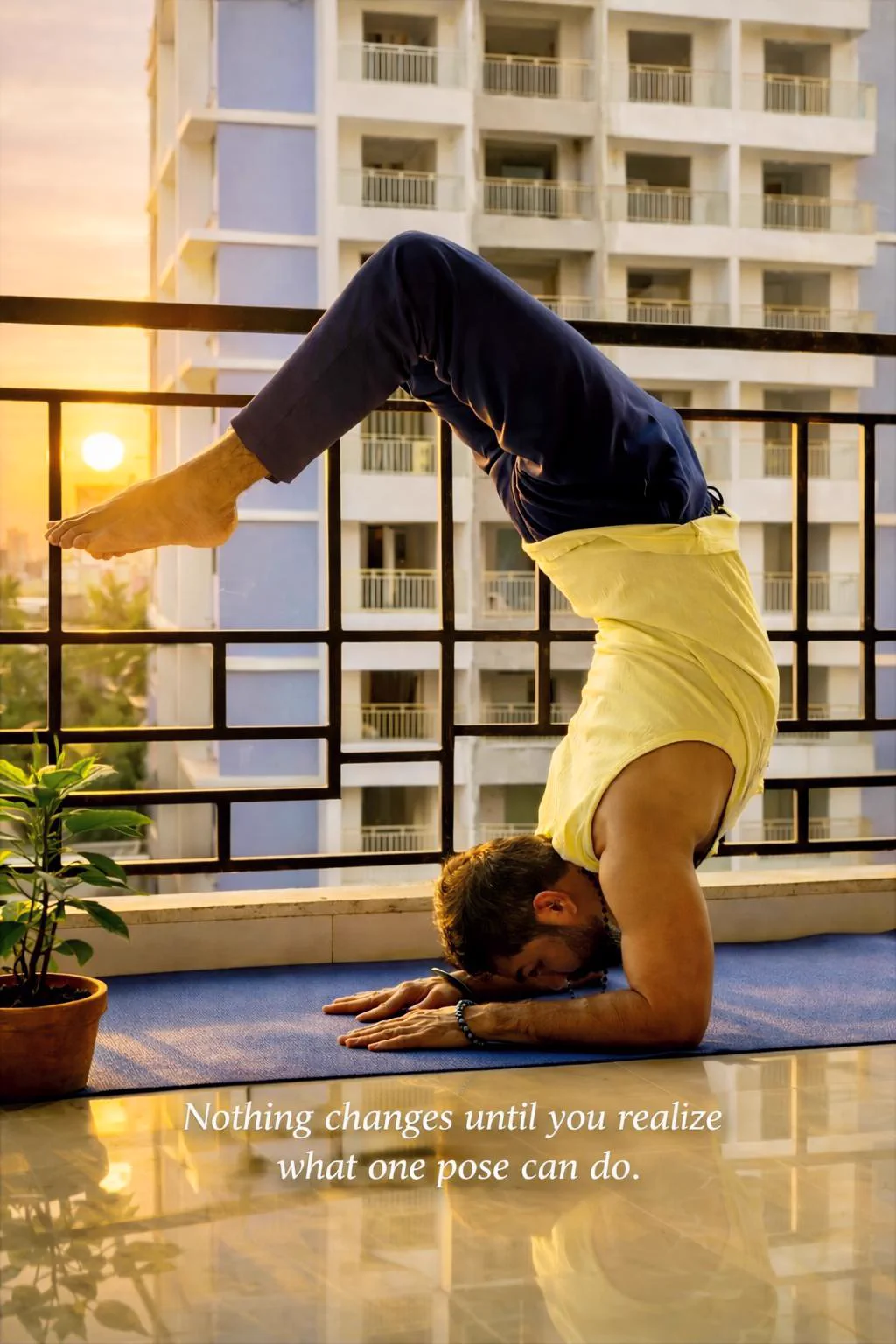
Forearm Stand (Pincha Mayurasana): Benefits for Focus, Strength & Confidence
There is something different about learning to balance upside down. Your surroundings disappear for a moment. Your attention moves away from emails, unfinished work, and everything competing for your time. Suddenly, the only thing that matters is your breathing, your balance, and what your body is telling you.
That is one of the interesting things about Forearm Stand yoga.
Also known as Pincha Mayurasana, Forearm Stand is an advanced yoga inversion in which you balance your body on your forearms. It requires shoulder strength, core stability, coordination, and a good understanding of body alignment.
But the challenge goes beyond physical strength.
The first few attempts can be frustrating. Your legs may not reach the wall. Your shoulders may feel tired. You might hesitate because being upside down feels unfamiliar.
And then there is the mental side of the experience. You have to manage fear, remain patient, and learn to recognize when your body is ready for another attempt.
For digital nomads who spend much of their day switching between screens, meetings, travel plans, and unfamiliar environments, this kind of focused movement can offer a welcome change of pace.
You do not need to master Pincha Mayurasana to experience its value. The preparation, the mistakes, and the gradual improvements are all part of the practice.
Let's explore what makes Forearm Stand such an interesting yoga pose, how it challenges your mind and body, and how to approach it safely.
What Is Forearm Stand (Pincha Mayurasana)?
Pincha Mayurasana is an advanced arm balance and inversion in which the body is lifted vertically while supported by the forearms.
The name is commonly translated as Feathered Peacock Pose. Unlike a Headstand, where the head forms part of the support structure, Forearm Stand places the primary weight-bearing demand on the forearms and shoulders.
The pose requires several physical abilities working together:
- Shoulder stability: Your shoulders and upper back help support and control the inverted position.
- Core strength: Your abdominal and trunk muscles help maintain alignment.
- Balance and coordination: Small adjustments throughout the body help you maintain stability.
- Mobility: Comfortable shoulder and upper-back mobility contribute to positioning.
- Body awareness: You need to recognize how your body responds as your weight shifts.
Although experienced practitioners can make the pose look effortless, it takes time to develop the strength and coordination required.
This is why learning Forearm Stand should be a gradual process rather than a repeated attempt to kick your legs into the air.
Why Does Forearm Stand Require So Much Focus?
There is a reason balancing upside down feels different from performing an ordinary strength exercise.
Your usual sense of orientation changes. You cannot rely on the same familiar movements you use when standing or walking. Your body needs to interpret balance through different physical signals.
Your shoulders respond to changes in pressure. Your core helps control movement. Your breathing becomes particularly noticeable when the effort increases.
Instead of allowing your attention to move between unrelated thoughts, you have a specific task that requires your presence.
For someone working remotely, this can be a refreshing experience.
You might spend the morning answering messages, move between browser tabs throughout the afternoon, and finish the day wondering where your attention went.
A focused yoga practice offers an opportunity to step away from that pattern.
Forearm Stand is not a scientifically established treatment for distraction or overthinking. However, learning the pose creates opportunities to practice concentration, awareness, and patience through physical movement.
5 Mental Benefits of Practicing Forearm Stand Yoga
The mental benefits of Pincha Mayurasana are best understood as lessons that can emerge through the learning process. They are not guaranteed psychological outcomes of performing the pose.
1. It Gives You an Opportunity to Practice Focus
When you are balancing upside down, your attention naturally moves towards the task.
You become more conscious of your breathing, shoulder position, core engagement, and small changes in balance.
There is less room to think about unrelated responsibilities.
This kind of deliberate attention can help you recognize how easily your concentration shifts during everyday activities.
The important lesson is not that Forearm Stand will automatically improve your productivity. It is that physical practice can give you a dedicated space to experience what focused attention feels like.
2. It Helps You Develop Confidence Through Progress
The first successful Forearm Stand is not necessarily the most important achievement.
For many practitioners, learning to hold Dolphin Pose comfortably or developing better shoulder stability is already a meaningful step.
You begin to understand that something unfamiliar can become more manageable through preparation and consistent effort.
That experience can influence how you approach challenges outside yoga.
A difficult project, an unfamiliar destination, or a new responsibility may initially feel uncomfortable. But instead of expecting immediate results, you become more willing to learn through smaller steps.
Confidence does not mean believing that you will succeed every time.
It means becoming more comfortable with the process of trying, learning, and improving.
3. It Teaches You to Work With Fear
Being upside down can feel intimidating, particularly if you have little experience with yoga inversions.
You may worry about falling, losing control, or putting too much pressure on your shoulders.
These reactions are understandable.
The answer is not to ignore fear or force yourself into the complete pose.
Instead, you learn to distinguish between ordinary uncertainty and genuine physical warning signs.
Working with an instructor, using appropriate preparation, and understanding how to exit an inversion safely can help make the learning process more controlled.
An important lesson emerges: confidence and caution can exist together.
4. It Encourages Patience
Balance does not develop according to a fixed timetable.
Some days your body feels strong and coordinated. On other days, even familiar movements feel difficult.
It is easy to become frustrated when a pose takes longer to learn than expected.
But comparing your progress with an experienced practitioner rarely helps.
You may be starting with different levels of strength, mobility, coordination, and previous yoga experience.
Forearm Stand encourages you to pay attention to your own progress rather than someone else's performance.
Sometimes improvement means holding Dolphin Pose with better control. Sometimes it means recognizing that you need rest.
Both are useful parts of a sustainable practice.
5. It Improves Awareness of Your Body
Forearm Stand involves several areas of the body working together.
Your shoulders and upper back support the position. Your core helps maintain stability, while your hips and legs influence alignment.
You also become more aware of how breathing changes during physical effort.
This awareness can be particularly useful for people who spend long periods sitting.
Digital nomads often move between laptops, cafés, coworking spaces, airports, and temporary accommodation. Exercise routines can become inconsistent when daily environments change.
Yoga provides an opportunity to reconnect with physical movement rather than spending the entire day in front of a screen.
Physical Benefits of Forearm Stand
Although the mental challenge makes Pincha Mayurasana interesting, it is also a demanding physical exercise.
With appropriate preparation and progressive practice, it can contribute to several aspects of physical fitness.
Upper-body strength and stability
The shoulders, upper back, and supporting muscles work together to maintain the inverted position. Developing these abilities can complement a broader strength-training routine.
Core strength
Your trunk muscles help control your body position and reduce unwanted movement. Maintaining a controlled inversion requires coordination rather than simply tightening your abdominal muscles.
Balance and coordination
Forearm Stand challenges your ability to coordinate several body movements simultaneously. Small changes in shoulder position, core engagement, and leg alignment can influence stability.
Shoulder mobility and body control
The pose requires an appropriate range of shoulder movement. Preparatory exercises can help develop strength and control within a comfortable range.
It is important to distinguish between the demands of the full pose and its preparatory exercises. Simply attempting Forearm Stand repeatedly is not a substitute for developing the necessary physical foundation.
How to Prepare for Forearm Stand: 5 Exercises
If you are new to yoga inversions, do not rush towards the complete Pincha Mayurasana.
Start by developing shoulder strength, core stability, and familiarity with supporting your body through your forearms.
Here are five useful preparatory movements.
1. Dolphin Pose
Dolphin Pose is one of the most relevant preparation exercises for Forearm Stand.
Your forearms remain on the mat while your hips lift upwards, creating an inverted V shape.
This position helps you become familiar with supporting your upper body through the forearms while developing shoulder stability.
Focus on:
- Keeping your forearms comfortably grounded.
- Maintaining steady breathing.
- Avoiding unnecessary tension in your neck.
- Moving only within a comfortable range.
Do not force your shoulders or try to bring your head towards the floor.
2. Forearm Plank
Forearm Plank develops core endurance and shoulder stability.
Begin with your forearms on the mat and your body supported by your toes. Maintain a comfortable alignment without allowing your lower back to collapse.
Rather than holding the position for as long as possible, prioritize controlled breathing and consistent technique.
If maintaining the position becomes uncomfortable, reduce the duration or use a modified version.
3. Downward-Facing Dog
Downward-Facing Dog is a familiar yoga posture that helps develop shoulder mobility, coordination, and body awareness.
It also gives you an opportunity to practice steady breathing while supporting your upper body.
Keep your knees slightly bent if that allows you to maintain a more comfortable position.
The goal is controlled movement, not forcing your heels towards the floor.
4. Shoulder Mobility Exercises
Comfortable shoulder mobility is important when preparing for an inversion.
Controlled shoulder circles, gentle overhead arm movements, and other instructor-recommended mobility exercises can help you become familiar with your available range of movement.
Avoid forcing your shoulders into uncomfortable positions.
If you experience pain or restricted movement, seek appropriate guidance before progressing.
5. Instructor-Guided Wall Preparation
A suitable wall setup can help experienced instructors introduce inversion positioning in a more controlled environment.
However, a wall does not eliminate the possibility of falling or injury.
Before attempting a full Forearm Stand, learn the correct entry, positioning, and exit techniques from a qualified yoga instructor.
Do not attempt unsupported kick-ups simply because you can perform the preparatory exercises.
A Simple 10-Minute Forearm Stand Preparation Routine
If you already have experience with basic yoga movements, you can organize some of the preparatory exercises into a short practice.
| Movement | Time |
|---|---|
| Gentle shoulder mobility | 2 minutes |
| Downward-Facing Dog | 1 minute |
| Dolphin Pose | 2 minutes |
| Forearm Plank | 2 minutes |
| Rest and controlled breathing | 1 minute |
| Instructor-guided inversion preparation | 2 minutes |
This is a general preparation example, not a test of readiness for the complete pose.
Beginners should focus on developing comfortable movement and foundational strength. The inversion-specific portion should only be attempted with appropriate instruction.
If your shoulders feel fatigued or your technique deteriorates, stop rather than pushing through.
Forearm Stand vs. Headstand: What's the Difference?
Both Forearm Stand and Headstand are advanced yoga inversions, but they have different physical demands and support requirements.
| Feature | Forearm Stand | Headstand |
|---|---|---|
| Sanskrit name | Pincha Mayurasana | Sirsasana |
| Main support | Forearms | Forearms and head, depending on variation |
| Primary physical demand | Shoulder stability and upper-body control | Upper-body strength, alignment, and balance |
| Core involvement | High | High |
| Balance challenge | Significant | Significant |
| Difficulty | Varies by practitioner | Varies by practitioner |
Neither pose is universally harder.
Someone with strong shoulders and experience in arm balances may find Forearm Stand more approachable. Another practitioner may be more comfortable with Headstand.
Both require proper instruction and preparation.
If you are interested in understanding the physical and mental aspects of another inversion, read our guide to Headstand Benefits: Body, Mind and Safety.
Forearm Stand Safety: What You Should Know Before Practicing
Pincha Mayurasana is an advanced inversion. It should not be treated as a beginner-friendly balance exercise.
The position places considerable demands on the shoulders, elbows, wrists, and upper back. Incorrect positioning, uncontrolled entry, or an unsafe exit can increase injury risk.
Before practicing:
- Learn the pose from a qualified yoga instructor.
- Develop sufficient shoulder strength and comfortable mobility.
- Practice on a suitable, non-slip surface with adequate space.
- Learn how to enter and exit the position safely.
- Avoid attempting inversions when exhausted, distracted, or physically unwell.
- Never force your neck or place your head under unnecessary pressure.
- Stop immediately if you experience pain, dizziness, numbness, or unusual discomfort.
People with existing shoulder, neck, spinal, eye, cardiovascular, or balance-related medical concerns should seek advice from an appropriate healthcare professional before attempting advanced inversions.
Pregnancy may also require avoiding or modifying inversions, depending on individual circumstances and previous experience. Seek individualized guidance rather than attempting an unfamiliar advanced pose.
Remember that choosing not to perform an advanced yoga posture is not a failure. Knowing your limits is part of practicing responsibly.
How Digital Nomads Can Build a Consistent Yoga Routine
Maintaining a fitness routine while traveling is not always straightforward.
One month you might have access to a fully equipped gym. The next month you may be working from a small apartment with limited floor space.
Your working hours may change, your sleep schedule may become irregular, and the familiar routines that supported your exercise habits may disappear.
This is one reason yoga can be a useful addition to a digital nomad fitness routine.
You do not need to make every session complicated.
A realistic approach could include:
- Morning mobility: Spend a few minutes moving your shoulders, hips, and spine before beginning work.
- Short movement breaks: Step away from your laptop and include some gentle stretching or walking between work sessions.
- Strength and stability: Include suitable exercises such as planks, bodyweight movements, and yoga preparation exercises.
- Breathing and relaxation: Give yourself a few quiet minutes to slow down after a demanding working day.
- Consistency over intensity: Maintain a manageable routine instead of expecting every session to be physically demanding.
Forearm Stand can eventually become a personal movement goal, but it does not need to be the centre of your entire yoga practice.
The larger objective is to maintain a healthy relationship with movement regardless of where you are living or working.
For more practical ideas, explore our guide to Forward-Bending Yoga for Stress Relief.
The Deeper Lesson: Progress Is More Important Than the Pose
There is a temptation to measure yoga progress through the positions you can perform.
You see someone balancing effortlessly in Forearm Stand and begin wondering how long it will take before you can do the same.
But the most useful part of learning Pincha Mayurasana may have very little to do with the final position.
It might be the first time you recognize that your shoulders need more preparation.
It might be learning to stop when your body feels fatigued instead of forcing another attempt.
Or it might simply be becoming comfortable with a movement that once seemed intimidating.
These experiences are small, but they change the way you approach physical challenges.
The same thinking applies to life outside the yoga mat.
When work becomes overwhelming, you can focus on the next manageable task rather than worrying about everything at once.
When travel disrupts your routine, you can find a realistic way to stay active instead of abandoning exercise completely.
And when progress feels slow, you can recognize that consistency matters more than perfection.
We explore this idea further in Consistency Myth: Showing Up Beats Perfect.
Frequently Asked Questions About Forearm Stand Yoga
1. What are the benefits of Forearm Stand in yoga?
Forearm Stand challenges shoulder stability, upper-body strength, core control, coordination, and balance. The learning process can also provide opportunities to practice concentration, body awareness, patience, and confidence.
2. Does Forearm Stand improve mental focus?
Forearm Stand requires attention to breathing, alignment, and balance. Practicing it can provide an opportunity to develop present-moment awareness. However, there is not enough pose-specific evidence to claim that performing Pincha Mayurasana independently improves everyday concentration.
3. Is Forearm Stand harder than Headstand?
It depends on the individual. Forearm Stand places substantial demands on shoulder stability and upper-body control, while Headstand has different balance and support requirements. Previous experience, strength, mobility, and coordination all influence which pose feels more difficult.
4. Can beginners practice Forearm Stand?
The complete Forearm Stand is an advanced yoga inversion and is generally not appropriate as a starting point for beginners. New practitioners should first develop shoulder stability, core strength, and familiarity with preparatory positions under suitable instruction.
5. How long does it take to learn Pincha Mayurasana?
There is no universal timeline. Progress depends on your starting strength, shoulder mobility, coordination, previous yoga experience, and consistency. Some practitioners may need several months or longer to develop the necessary foundation.
Avoid rushing the process. Safe preparation is more important than reaching the full pose quickly.
6. What muscles does Forearm Stand work?
Forearm Stand primarily challenges the shoulders, upper back, arms, and core. Other muscles throughout the body contribute to maintaining alignment and balance.
7. Is Forearm Stand good for beginners who want to improve balance?
Beginners can develop balance through simpler standing poses and foundational yoga movements. The complete Forearm Stand is an advanced progression and should not be the first balance exercise someone attempts.
8. Can digital nomads practice yoga without a gym?
Yes. Many basic yoga movements can be practiced in a suitable space without gym equipment. A yoga mat can be useful, although the exercises you choose should reflect your experience, available space, and physical abilities.
For advanced inversions such as Forearm Stand, appropriate instruction and a safe practice environment remain important.
9. Can yoga help digital nomads improve focus?
Yoga provides opportunities to practice breathing awareness, concentration, and mindful movement. Including a manageable yoga routine alongside regular breaks, physical activity, and adequate rest can support a more balanced remote-working lifestyle.
Final Thought
Sometimes mental clarity does not begin with another productivity technique. It begins when you step away from everything competing for your attention and reconnect with your body.
Forearm Stand is a reminder that progress takes preparation, confidence takes experience, and balance is something you learn gradually.
You do not have to master Pincha Mayurasana to understand its deeper lesson.
Pay attention. Work within your limits. Keep showing up.
And remember that the real achievement is not always standing upside down. Sometimes it is simply becoming a little stronger, more patient, and more aware than you were yesterday.
Related Articles
Headstand Yoga Benefits: Physical, Mental & Safety Guide
Explore headstand yoga benefits for strength, balance, and focus. Understand potential risks, preparation techniques, and safer alternatives.
It's Never Too Late: Forward Bending Yoga
Explore how forward bending yoga supports flexibility, mobility, relaxation, and body awareness. Discover gentle ways to develop a calmer mind.
Fitness Consistency: How to Build Workout Discipline That Lasts
Build a consistent workout routine, develop lasting fitness discipline, and make steady progress even when motivation fades or workouts aren't perfect.
Mental Clarity: How to Stop Overthinking and Improve Focus
Learn practical ways to stop overthinking, sharpen your focus, quiet mental noise, and regain control of your attention through simple daily habits.
You Are Not Stuck: Break Familiar Patterns and Grow
Feel stuck in life? Discover how familiar patterns shape your thinking and learn to challenge old habits, gain perspective, and create meaningful change.