Every Pull Burns, Every Climb Transforms: The Complete Guide to Rope Climbing
A comprehensive guide to mastering rope climbing, from understanding the mechanics to building the necessary strength and safety practices.
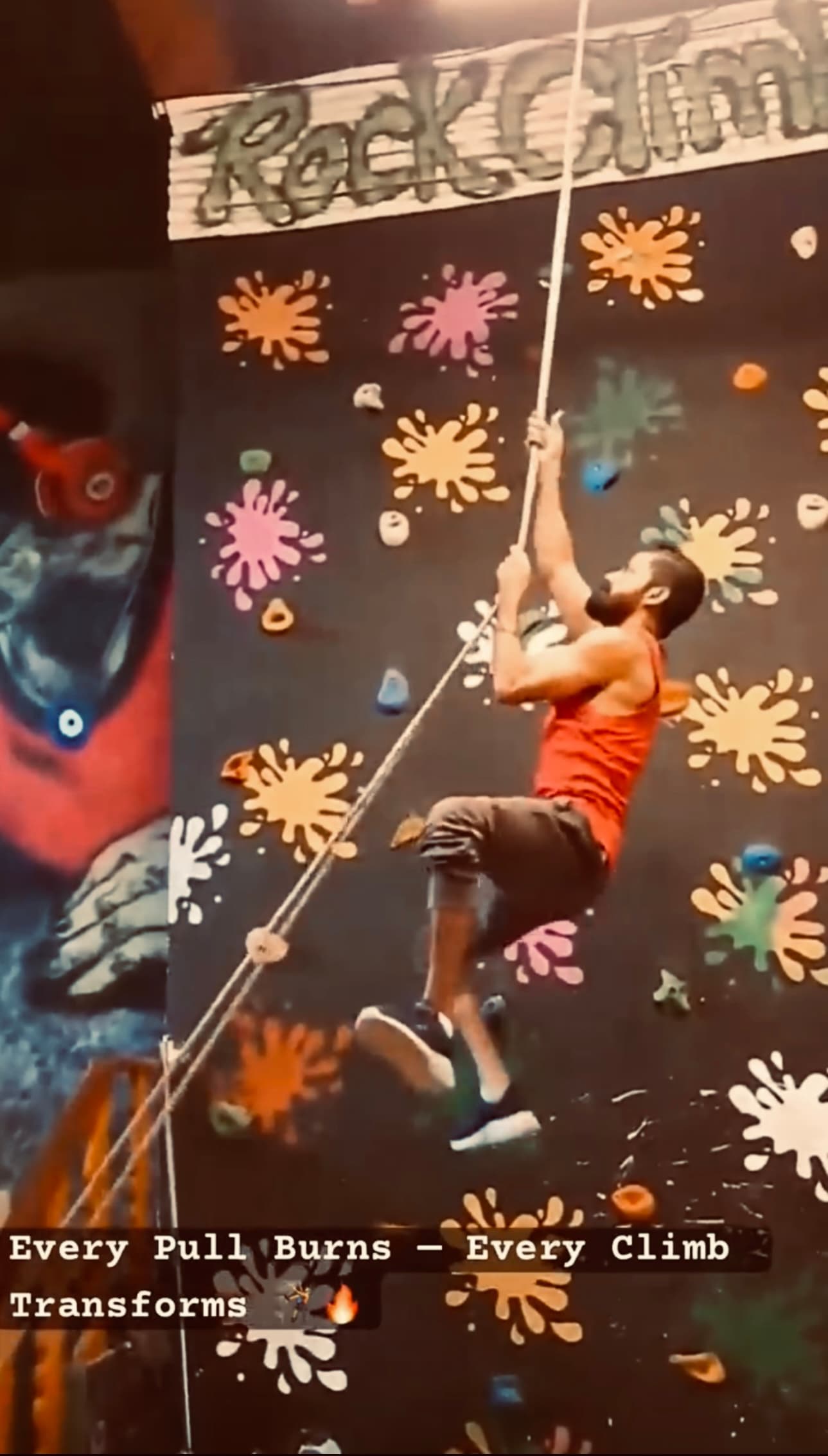
Every Pull Burns, Every Climb Transforms: The Complete Guide to Rope Climbing
There is something different about climbing a rope.
You grab it, look up, and suddenly the distance between your hands and the top feels much greater than it did from the ground.
Your grip tightens. Your forearms engage. Your shoulders and back activate. Your legs search for position. Your breathing gets heavier.
Then comes the burn.
But rope climbing is much more than a test of how hard you can pull.
It is a demanding combination of grip strength, pulling power, coordination, technique, body control, conditioning, and composure under fatigue.
You are not simply trying to reach the top.
You are learning how to solve a physical problem while your body is telling you to stop.
And every climb gives you another opportunity to solve that problem better.
Watch the Climb
Want to see the challenge for yourself?
Watch the featured rope-climbing video and pay attention to the details.
Notice how the climber manages hand placement.
Watch how the legs contribute.
Look at the rhythm of the movement.
Pay attention to how the body stays controlled rather than swinging unnecessarily.
NomadLifeXP: Every Pull Burns, Every Climb Transforms
The goal is not simply to copy an advanced climber.
Study the movement.
Understand the technique.
Then build your own ability progressively.
Why Rope Climbing Is Such a Powerful Exercise
Many exercises emphasize one movement pattern or one primary muscle group.
Rope climbing is different.
Your entire body has to cooperate.
Your hands and fingers keep you connected to the rope. Your forearms maintain your grip. Your biceps and shoulders contribute to the pull. Your lats and upper back help drive the movement.
Your core stabilizes your torso and limits unnecessary swinging.
And when you use an effective foot-lock technique, your legs can contribute significantly to the ascent.
Nothing works completely on its own.
That is what makes rope climbing such a valuable functional movement.
You are not simply developing strength.
You are learning how to coordinate strength.
And that distinction matters.
It is one thing to have strong muscles.
It is another to know how to use them together.
What Muscles Does Rope Climbing Work?
Rope climbing is a full-body exercise, although some muscle groups experience particularly high demands.
Grip and Forearms
Your hands are your connection to the rope.
Your fingers, wrists, and forearms must maintain that connection while your body repeatedly changes position.
For many beginners, grip endurance becomes a limiting factor surprisingly quickly.
That does not necessarily mean you are weak.
It may simply mean your grip is not yet accustomed to the specific demands of climbing.
Exercises such as dead hangs, carries, pull-ups, rows, and progressive rope work can help develop the strength and endurance needed to hold and control the rope.
Back and Lats
Your lats and upper back play a major role in pulling your body upward.
Rather than thinking only about bending your elbows, think about bringing your body toward the rope while keeping your movement controlled.
Efficient climbing uses your back instead of turning every movement into an exhausting arm-dominant pull.
The stronger and more coordinated your back becomes, the easier it is to distribute the workload.
Biceps and Shoulders
Your biceps and shoulders assist with repeated pulling and hand repositioning.
They work hard, but they should not be expected to carry the entire climb.
The more effectively you use your back, core, and legs, the less unnecessary work your arms have to perform.
Core
Your core helps keep your body organized while you climb.
A controlled torso reduces excessive swinging and helps transfer force between your upper and lower body.
Better body control also means less energy wasted fighting your own momentum.
Legs
This is where many beginners misunderstand rope climbing.
The hands are doing the most obvious work, so it is easy to assume the exercise is purely an upper-body challenge.
With an appropriate foot-lock technique, however, your legs can make a substantial contribution.
You can secure the rope around your feet, establish a stable platform, and stand upward.
Your arms still pull.
But your legs help you gain height.
And that can completely change how the climb feels.
Your Legs Can Save Your Arms
Try climbing a rope using only your arms and you will quickly understand the problem.
Your forearms fatigue.
Your grip weakens.
Your pulling becomes less efficient.
The top suddenly looks much farther away.
That does not automatically mean you are too weak to climb.
It may mean you are climbing inefficiently.
A properly learned foot lock allows you to establish a stable position and use your legs to assist the ascent.
Instead of asking your arms to lift your entire body continuously, you can use a repeating sequence:
Grip → pull → secure the rope → stand → reach higher → repeat.
That is the basic idea behind efficient rope climbing.
The goal is not to make your arms work as little as possible.
The goal is to make your entire body contribute.
Rope Climbing Technique: The Basic Movement
Before worrying about height, learn the movement pattern.
A basic rope climb with a foot lock can be viewed as a repeating sequence.
-
Establish Your Grip
Hold the rope securely with both hands. Your grip should be firm and controlled rather than unnecessarily tense. Save energy for the climb itself. -
Pull Your Body Up
Use your arms and back to bring your body higher. Avoid frantic pulling. Smooth, deliberate movement generally makes it easier to conserve energy and maintain control. -
Establish the Foot Lock
Use the rope and your feet to create a secure platform using the technique taught in your training environment. This is the point where your lower body becomes a major part of the movement. -
Stand Through Your Legs
Rather than continuously pulling with your arms, use the foot lock to help raise your body. Think: Stand upward. Your arms reposition you; your legs help drive you upward. -
Reach Higher
Once your body has risen, move your hands higher on the rope. Re-establish your position and repeat the sequence.
The exact mechanics vary between foot-lock techniques, but the underlying principle remains the same:
Pull less. Coordinate more.
Learning the J-Hook
The J-hook is one commonly taught rope foot-lock technique.
The exact setup can vary depending on the rope, facility, footwear, athlete, and coaching method, so beginners should ideally learn it through direct instruction.
The basic objective is to position the rope around the feet so it can be secured and used as a platform for standing.
At first, this can feel surprisingly awkward.
Your feet may not cooperate.
The rope may move.
You may struggle to understand exactly where your feet should go.
That is normal.
Do not practice your first foot locks high above the ground.
Stay low and focus on the mechanics.
Practice:
- Establishing the position
- Releasing it
- Standing on the secured rope
- Repositioning your hands
- Combining the foot lock with a controlled pull
Once the movement becomes automatic, adding height becomes much easier.
Technique first. Height later.
The S-Hook and Other Foot-Lock Variations
The S-hook and other foot-lock variations provide alternative ways to secure the rope with the lower body.
Different climbers may prefer different techniques based on experience, mobility, footwear, rope diameter, and the equipment being used.
There is no prize for choosing the technique that looks the most complicated.
The best technique is the one you can perform reliably, efficiently, and safely within your training environment.
If you are new to rope climbing, have an experienced coach demonstrate and supervise the technique whenever possible.
A small change in foot position can make a surprisingly large difference.
What About Climbing Without Your Legs?
Once you have developed a strong foundation, you may eventually want to attempt a legless rope climb.
That is a significant progression.
Without your legs assisting the movement, your grip, pulling muscles, upper back, shoulders, arms, and core must handle substantially more of the workload.
It looks impressive because it is difficult.
But there is no reason to rush toward it.
If you cannot perform controlled rope climbs with reliable technique, jumping directly into legless climbing is an unnecessary challenge.
Build the foundation first.
Master the foot lock.
Develop your grip.
Improve your pulling strength.
Learn to manage fatigue.
Then decide whether you are ready for the next progression.
Advanced skills become much more achievable when the basics are automatic.
The Mental Challenge Is Real
Rope climbing exposes the connection between your mind and your body very quickly.
You may start the climb feeling confident.
Then you reach the halfway point.
Your forearms are burning.
Your breathing is heavier.
Your grip no longer feels as secure as it did at the beginning.
You look toward the top.
For a moment, the distance feels enormous.
That moment is part of the training.
Instead of thinking about the entire climb, focus on the movement immediately in front of you.
Secure your position.
Move your hands.
Set your feet.
Stand.
Reset.
Reach again.
You do not have to solve the entire climb at once.
You only have to execute the next movement.
The ability to stay focused through discomfort can be valuable far beyond the gym.
Do Not Confuse Discomfort With Pain
Hard exercise can be uncomfortable.
Your muscles may burn. Your breathing may become heavy. Your grip may fatigue.
That is different from injury-related pain.
Sharp pain, sudden joint pain, unusual symptoms, or a significant loss of control are not things you should simply push through.
If something feels wrong, stop the activity and assess the situation.
If pain persists or you are concerned about an injury, seek appropriate professional advice.
Being tough does not mean ignoring warning signs.
Smart training includes knowing when to push and when to stop.
The Biggest Rope-Climbing Mistakes
-
Using Only Your Arms
Your hands are attached to the rope, so it feels natural to pull as hard as possible. But efficient climbing involves your entire body. Learn the foot lock. Stand through your legs. Use your back. Coordinate the movement. -
Climbing Too Fast
Fast does not automatically mean efficient. Rushing can cause you to waste energy, lose your foot position, or become difficult to control. Learn smooth movement first. Speed can come later. -
Ignoring the Descent
Reaching the top is not the end of the exercise. You still have to come down. Do not simply slide rapidly down the rope. Excessive friction can cause painful rope burns, while losing control during the descent can increase the risk of a fall. Learn the appropriate descent technique for the equipment and environment you are using. -
Looking Only at the Top
Constantly staring at the destination can make the climb feel harder. Instead, focus on the next movement: Hand. Foot. Stand. Reach. Repeat. -
Trying to Do Too Much Too Soon
You do not need to reach the top on your first session. You do not need to climb legless. You do not need to prove anything. Your first objective is to learn the movement, repeat it, and then improve it.
Warm Up Before You Climb
Rope climbing can place significant demands on your hands, wrists, elbows, shoulders, back, and core.
A sensible warm-up prepares those areas for the activity.
Begin with several minutes of general movement to raise your body temperature.
Then use controlled mobility and activation exercises appropriate to your training level.
Follow with easier pulling movements before attempting a demanding climb.
The principle is simple:
Do not make your first serious effort of the day your hardest effort of the day.
Your warm-up should prepare you to climb—not exhaust you before you touch the rope.
Rope Climbing Safety Matters
Rope climbing should be challenging.
It should never be careless.
Before climbing, inspect the rope and its attachment system.
Look for obvious signs of:
- Fraying
- Cuts or damage
- Excessive wear
- Loose or damaged hardware
- Problems with the attachment point
- Any other condition that could compromise the setup
Check the area beneath the rope as well.
The landing surface should be appropriate for the activity, with suitable padding where required by the facility and equipment.
Beginners should learn in a properly equipped environment and, ideally, under the guidance of an experienced instructor or coach.
Never assume unfamiliar equipment is safe simply because it looks strong.
And never climb a setup you do not understand.
The equipment matters. The environment matters. Your technique matters. Your judgment matters most of all.
How to Start If You Have Never Climbed Before
You do not need to walk into your first session and attempt a full climb.
Build the foundation first.
Useful preparatory exercises can include:
- Pull-ups or assisted pull-ups
- Rows
- Dead hangs
- Loaded carries
- Controlled pulling exercises
- Core stability work
Then introduce the rope gradually:
- Beginner Stage 1: Build Your Grip — Learn how to hold the rope securely. Practice hanging and repositioning your hands.
- Beginner Stage 2: Learn the Foot Lock — Practice your chosen foot-lock technique close to the ground. Learn to establish and release it consistently.
- Beginner Stage 3: Learn to Stand — Practice using the foot lock to stand upward. This teaches your legs to contribute to the movement.
- Beginner Stage 4: Perform Short Climbs — Combine the grip, pull, foot lock, and stand. Climb only a short distance.
- Beginner Stage 5: Master the Descent — Learn how to come down safely before attempting greater heights.
- Beginner Stage 6: Progress to Full Climbs — Once the fundamentals are reliable, gradually increase the distance.
The goal of your first sessions should be skill development—not maximum height.
How to Know You Are Getting Better
Progress is not always measured by reaching the top.
Maybe you used to lose your grip after ten seconds and now you can hold it for twenty.
Maybe your foot lock used to take several attempts, while now you establish it immediately.
Maybe your first climb felt chaotic, while your latest one feels controlled and smooth.
Maybe you can reach the same height with less fatigue.
Maybe your descent is now controlled instead of rushed.
Those are all meaningful improvements.
Fitness is not always about doing something bigger. Sometimes it is about doing the same thing better.
Rope Climbing Teaches You to Stay With the Problem
This may be the lesson that stays with you the longest.
The rope gives you immediate feedback.
If your grip is weak, you discover it.
If your technique is inefficient, fatigue exposes it.
If you waste energy, fatigue catches up with you.
But that feedback is valuable.
You can make an adjustment.
Change your foot position.
Slow down.
Improve your breathing.
Reposition your hands.
Try again.
Eventually, something that once seemed impossible becomes familiar.
Then manageable.
Then repeatable.
Eventually, it becomes something you can do with confidence.
That progression is hard to replace.
The Goal Is Not to Never Struggle
Rope climbing is supposed to challenge you.
There will be days when everything clicks.
There will also be days when the rope feels heavier than usual.
Your grip will fail sometimes.
Your technique will break down when fatigue arrives.
You may look upward and wonder why you decided this was a good idea.
That does not necessarily mean the session was a failure.
It may simply mean you found the edge of your current ability.
The important question is: What did the climb teach you?
Maybe you need more grip endurance.
Maybe your foot lock needs work.
Maybe you climbed too quickly.
Maybe your pulling strength needs development.
Maybe you simply need more practice.
Identify the problem.
Adjust your approach.
Come back better prepared.
Rope Climbing FAQ
Is rope climbing a good full-body workout?
Yes. Rope climbing can challenge the grip, forearms, arms, shoulders, upper back, core, and legs, particularly when an effective foot-lock technique is used.
Is rope climbing difficult for beginners?
It can be. Beginners commonly struggle with grip endurance, pulling strength, coordination, and foot-lock technique. Starting with short climbs and practicing the technique close to the ground can make the learning process more manageable.
Can you climb a rope without strong arms?
You need sufficient upper-body and grip strength for safe climbing, but technique can dramatically affect how difficult the movement feels. Learning to use your legs through a foot lock can reduce the amount of work your arms have to perform.
Can you learn rope climbing without doing pull-ups?
Yes. Pull-ups can be useful preparation, but they are not the only way to develop the necessary qualities. Assisted pull-ups, rows, hangs, carries, and progressive rope exercises can all help build a foundation.
Is climbing a rope good for grip strength?
Yes. Rope climbing places substantial demands on grip strength, endurance, and control. Beginners should progress gradually because grip fatigue can compromise their ability to maintain a secure position.
What is a J-hook in rope climbing?
A J-hook is a commonly taught foot-lock technique that uses the rope and feet to create a platform that allows the climber to stand and gain height.
Should beginners try legless rope climbs?
Generally, legless climbing should be treated as an advanced progression rather than a starting point. Build grip strength, pulling ability, body control, and regular climbing technique first.
How often should you practice rope climbing?
The appropriate frequency depends on your training experience, recovery, overall program, and how demanding your sessions are. Beginners should allow adequate recovery rather than attempting hard climbs every day.
Keep Climbing
Rope climbing has a way of humbling you quickly.
You can be strong in the gym and still struggle with your first climb.
You can have a powerful upper body and discover that your grip is your weakest link.
You can be nervous about the height and gradually become comfortable with it.
That is part of what makes the exercise so rewarding.
You are not simply building stronger arms or a stronger back.
You are learning to coordinate your body, manage fatigue, solve movement problems, and stay composed when the easy option is to stop.
The first time you reach the top, you will probably remember it.
Not because it was easy.
Because it wasn't.
You earned it one movement at a time.
So take your time.
Learn the technique.
Respect the equipment.
Train consistently.
Progress at your own pace.
And when the burn starts and your arms tell you that you are finished, do not panic.
Take a breath.
Secure your position.
Reach for the next handhold.
Then the next.
Keep climbing.
Every pull burns. Every climb transforms. 🧗♂️🔥
Keep climbing.
Keep improving.
Become stronger, smarter, and more capable with every ascent.
Final Takeaway
Mastery isn’t about forcing your way up at all costs.
It’s about climbing smarter, respecting the equipment, refining your technique, and treating every failure as an invitation to train your weaknesses.
Every difficult climb gives you information.
Every missed foot lock shows you what needs more practice.
Every moment your grip gives out reveals another quality you can develop.
Every time you reach a little higher, move more efficiently, or recover a little faster, you prove that progress does not always arrive as a dramatic breakthrough.
Sometimes it comes one adjustment at a time.
So learn the movement.
Build the strength.
Respect the rope.
Control the climb.
Accept the struggle.
And keep improving.
Every pull burns. Every climb transforms. Keep climbing.
Related Articles
How to Build a Workout Habit That Outlasts Your Motivation
Motivation is a volatile emotional state. If you only exercise when you feel inspired, your fitness journey will remain completely inconsistent. True behavioral change occurs when training transforms from an emotional decision into an automatic identity choice. By engineering environmental triggers and scaling down friction points, you can construct a workout habit that executes seamlessly, even on your lowest energy days.
Fitness Is Not About Time: Mindset, Discipline, and Consistency over Motivation
Stop waiting for the perfect, unbusy moment. Discover why long-term health and fitness depend on small daily actions rather than finding hours of free time.
Fitness Consistency: How to Build Workout Discipline That Lasts
Build a workout routine you can stick with, develop lasting fitness discipline, and make steady progress even when motivation fades and workouts aren't perfect.
Indoor Rock Climbing: Strength, Balance & Mental Resilience
Discover how indoor rock climbing builds strength, balance, coordination, focus and mental resilience while teaching you to adapt, solve problems and grow.
Why People Watch Workout Videos but Never Actually Exercise
Discover why watching fitness content gives your brain a false sense of achievement and how to break free from passive consumption to build actual physical habits.